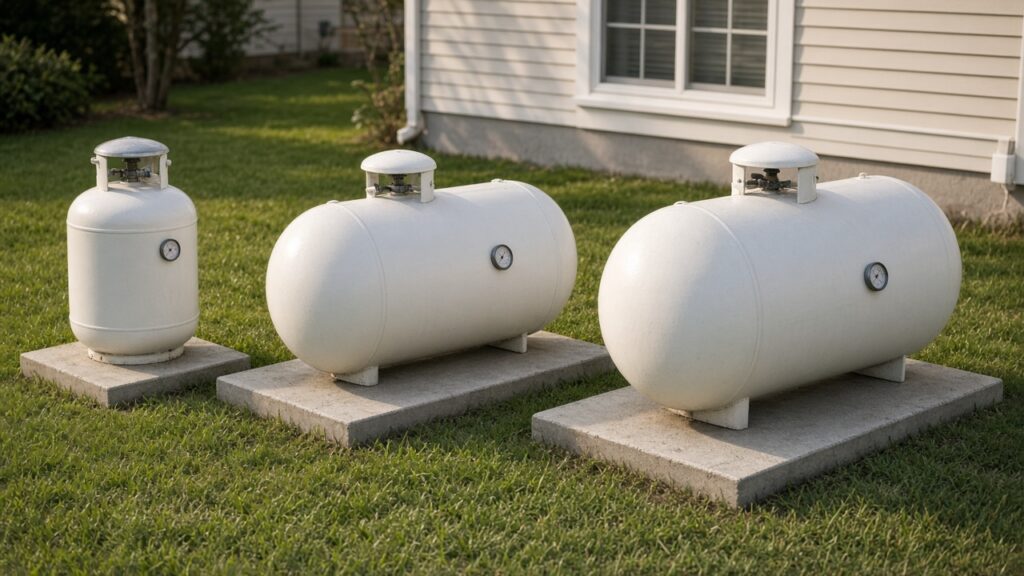
A 500-gallon propane tank holds about 400 gallons of propane when the delivery driver calls it full. A 20 lb grill cylinder holds about 4.7 gallons. Those two numbers get mixed up constantly, because portable cylinders are labeled in pounds and home tanks are labeled in gallons of water capacity.
The short version
Use a 20 lb cylinder for a grill or patio heater. Use a 120- or 250-gallon tank when propane runs a water heater, range, or dryer and does not heat the house. Use a 500-gallon tank when a furnace is the main heat. Use a 1,000-gallon tank for a large house, a pool heater, a standby generator, or fewer winter deliveries. The photo at the top shows relative size only. It is not an installation diagram. A real tank has to sit farther from the house than the tanks in that picture.
Propane tank size chart
Portable cylinders and home tanks use different labels. Read the matching table. Dimensions are typical and vary by manufacturer. The collar stamp or data plate on your tank is the number that counts.
Portable cylinders (sized in pounds of propane)
| Cylinder | Propane when full | About how many gallons | Rough size | Typical use |
|---|---|---|---|---|
| 20 lb | 20 lb | 4.7 gal | 18 in tall, 12 in across | Grill, patio heater, small portable generator |
| 30 lb | 30 lb | 7.1 gal | 24 in tall, 12 in across | Larger grill, food truck, some RVs |
| 40 lb | 40 lb | 9.4 gal | 29 in tall, 12 in across | High-output cooking, job-site heaters |
| 100 lb | 100 lb | 23.6 gal | 48 in tall, 15 in across | Construction heat, temporary use, a very small cabin |
Gallon figures use 4.24 pounds per gallon, the usual weight of propane at 60°F. A 1 lb camping canister is a separate product with a different valve. It will not screw onto a grill.
Home tanks (sized in gallons of water capacity)
| Water capacity | Propane at an 80% fill | Typical shape and size | A reasonable fit |
|---|---|---|---|
| 120 gal | 96 gal | Often vertical, about 4 ft 6 in tall and 30 in across | Water heater plus a range or dryer. A weak choice for a furnace in a cold climate. |
| 250 gal | 200 gal | Horizontal, about 7 ft 10 in long and 30 in across | Several appliances, or heat in a mild climate or a small house |
| 500 gal | 400 gal | Horizontal, about 10 ft long and 37–38 in across | The usual whole-home tank: furnace, water heater, range, and dryer |
| 1,000 gal | 800 gal | Horizontal, about 16 ft long and 41 in across | Large homes, a pool heater, a standby generator, or fewer winter deliveries |
Some suppliers also set a 320- or 330-gallon tank. At an 80% fill that is about 256 gallons of propane, a step between the 250 and the 500. Underground tanks use these same gallon ratings. Burying a tank does not change how much fuel it holds.
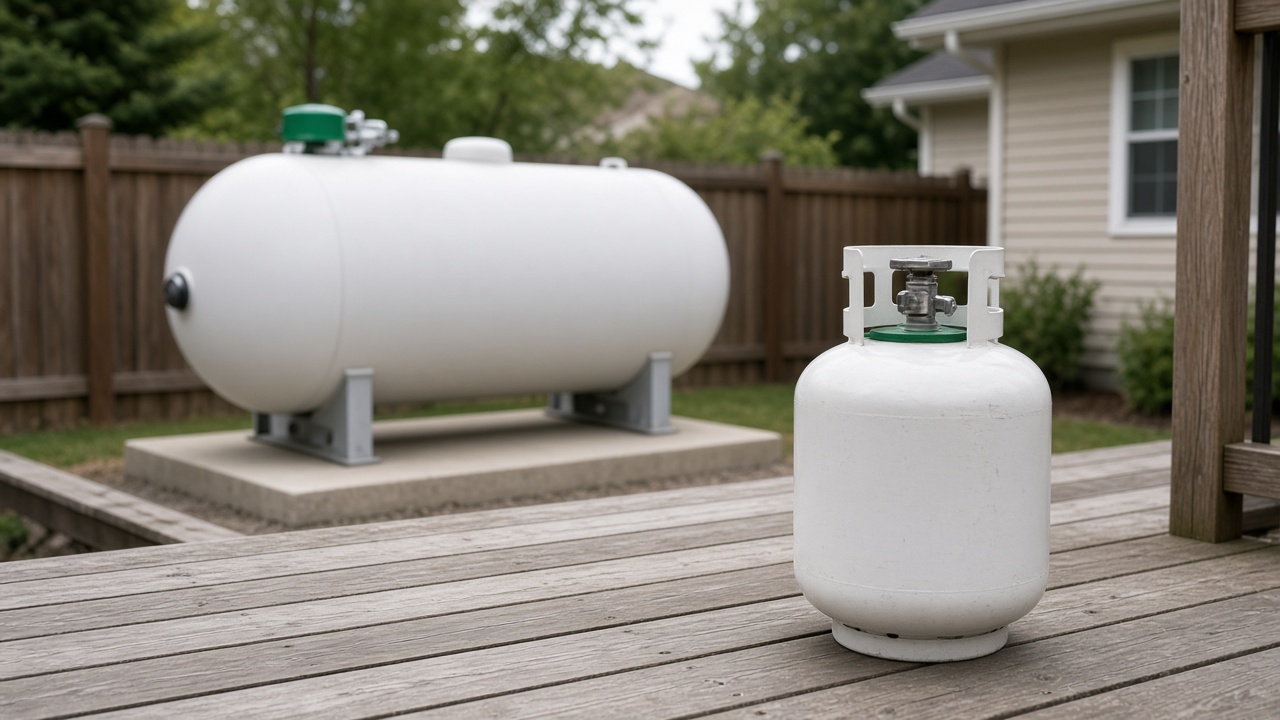
Why a full home tank is about 80 percent
Propane is stored as a liquid and it expands as it warms. The space left at the top of an ASME home tank is there so a hot afternoon does not force liquid out of the relief valve. Suppliers stop the fill at about 80% of the tank’s water capacity.
That is why the name on the tank and the gallons you can burn are different:
- 120-gallon tank → about 96 gallons of propane
- 250-gallon tank → about 200 gallons of propane
- 500-gallon tank → about 400 gallons of propane
- 1,000-gallon tank → about 800 gallons of propane
A 20 lb cylinder is already rated by the pounds of propane it is built to hold. The 80% vapor space was accounted for when the cylinder was rated. A full 20 lb cylinder contains 20 pounds of propane, about 4.7 gallons. Do not take 80% of 20 pounds a second time.
How to read the gauge after a delivery
On a typical float gauge, the number is the percent of the tank that contains liquid. A fresh delivery stops near 80%, so the needle usually sits near 80% when the driver leaves, not at 100%.
A needle at 30% on a 500-gallon tank means about 150 gallons are still in the tank (30% of 500). It does not mean 30% of the 400 gallons you started with. In winter, order a delivery while the gauge is still near 30%. A truck may not arrive the same day, and running the tank dry can shut off the furnace and require a leak check before the system is turned back on.
Gauges stick, especially in ice. If the needle has not moved in weeks while the heat is running, call the supplier and ask them to confirm the level. Many companies can also put a monitor on the tank and schedule the truck from that reading. Scheduled delivery and will-call service are the two ways that account usually works.
Which tank size fits the house
Match the tank to the appliances, not to a guess about square footage.
- Grill, fire pit, or patio heater only. Stay with a 20 lb cylinder. Exchange it or refill it. A home tank is the wrong tool. See how tank exchange works and the grill safety steps.
- Range and water heater, no furnace. A 120-gallon tank is the common starting point. You get about 96 gallons of fuel per fill.
- Range, water heater, dryer, and light heat, or a small cabin. A 250-gallon tank (about 200 gallons of fuel) is the usual step up.
- A furnace that heats the house. Start the conversation at 500 gallons (about 400 gallons of fuel) unless a load calculation says otherwise. This is the tank most whole-home customers end up with.
- A large house, a pool heater, a generator that has to run for days, or you want one or two deliveries all winter. Ask about a 1,000-gallon tank (about 800 gallons of fuel).
An RV tank is a different product. Motorhome tanks are often small ASME tanks in the 20- to 40-gallon range, or DOT cylinders. A forklift cylinder is different again. Warehouse fuel is covered in the forklift and tank-monitoring guide.
Estimate gallons from the appliance label
One gallon of propane contains about 91,500 BTU. The input rating is printed on the appliance data plate in BTU per hour. That rating is the burner running, not the appliance sitting idle.
Gallons ≈ (BTU per hour × hours the burner actually runs) ÷ 91,500
Example: an 80,000 BTU furnace that fires for 6 hours in a day uses about 80,000 × 6 ÷ 91,500, which is about 5.2 gallons that day. Across a 30-day cold month that is about 157 gallons for heat alone. A water heater adds more. A tank-style water heater often adds on the order of a few dozen gallons in a normal month, and a lot more if several people take long showers.
Put that next to the tank you are considering. A 500-gallon tank gives you about 400 gallons after a fill. At 5 gallons a day, that fill lasts a long time. At 12 gallons a day in a hard freeze, 400 gallons is about a month, and the order should already have been placed when the gauge was near 30%.
Insulation, the thermostat, and how often the burner cycles will move this number. Use it to sanity-check a quote. Let the supplier run a load calculation before they set the tank. Related reading: propane space heating, tank vs. tankless water heaters, and portable vs. standby generators.
How to find the size of the tank you already have
Read the data plate on the tank collar or tank head.
- On a home tank, look for water capacity, often marked WC, in gallons or in pounds of water. A plate that says 500 gallons WC is a 500-gallon tank, which holds about 400 gallons of propane when full.
- On a grill cylinder, the collar stamp that says 20 lb means 20 pounds of propane, about 4.7 gallons. It does not mean a 20-gallon tank.
If the plate is painted over or missing, the company that fills the tank has the size on the account. Do not guess from how big the tank looks. A 250 and a 500 can look similar from across the yard.
Above ground, underground, and who owns the tank
Above-ground tanks are easier to inspect and usually cheaper to set. Underground tanks stay out of the weather and out of the view, and they cost more to install and to dig up later. Pick the gallon size first. The decision to bury it is separate.
Most homeowners lease the tank from the company that delivers the fuel. The lease is why a “free tank” offer shows up in quotes. Ask three things before you accept a size:
- Who owns the tank if you switch suppliers?
- What does it cost to set this size, including the line to the house?
- Is the price you were quoted the fuel only, or fuel plus delivery, hazmat, and a low-usage fee?
The home tank buyer’s guide covers lease versus purchase. The delivery guide covers how routes are scheduled.
When a bigger tank is the wrong fix
A larger tank helps when you are burning through fuel between deliveries. It does not help when the real problem is that nobody is watching the gauge. If you ran out once because the dial sat at 10% for a week, fix the ordering habit or add a monitor before you pay to set a 1,000-gallon tank.
A 100 lb cylinder is a poor stand-in for house heat. At about 24 gallons, one cylinder is a day or two of furnace use in a cold snap, and you are hauling steel every time. That job belongs on a delivery account.
Placement is a code question, not a photo. NFPA 58 and the local fire code set how far a tank sits from the house, windows, property lines, and sources of ignition, and the distance grows with tank size. The supplier measures it. The fire department or building office may have to sign off.
Stop and get help if something is wrong
A rotten-egg smell, a hiss at a valve, or frost right on a fitting is a reason to leave. Get away from the tank before you use a phone, a light switch, or a car starter. From a safe distance, call 911 and the propane supplier. Frost or sweat on the body of the tank during a heavy draw in cold weather can be normal, because the liquid is boiling off and cooling the steel. Frost at a connection is not the same thing. Do not look for a leak with a flame. Do not set, move, or dig up a tank yourself.
Questions to settle before you order
How many gallons are in a 20 lb propane tank?
About 4.7 gallons. The 20 is pounds of propane. A 30 lb cylinder is about 7.1 gallons, a 40 lb cylinder is about 9.4 gallons, and a 100 lb cylinder is about 23.6 gallons.
Does a 500-gallon propane tank hold 500 gallons of propane?
No. Five hundred gallons is the water capacity. A normal fill is about 80%, which is about 400 gallons of propane. The same rule makes a 120-gallon tank about 96 gallons of fuel, a 250-gallon tank about 200, and a 1,000-gallon tank about 800.
What size propane tank does a typical house use?
If propane heats the house, suppliers usually start at 500 gallons. Homes that only run a water heater and a range often use 120 or 250 gallons. A 1,000-gallon tank is for high use or for stretching the time between deliveries.
What does the gauge read when the tank is full?
Usually about 80%, because that is where the driver stops. A reading of 100% on a home tank is not the goal, and a tank filled that high has no room for the liquid to expand.
How far does the tank have to sit from the house?
Farther than the photo at the top of this page. The required distance depends on tank size and on local adoption of NFPA 58. Ask the supplier to mark the spot, and check with the local fire authority before anyone digs or pours a pad.
Need a tank set or a refill account?
Compare suppliers that deliver to your address, then ask each one which tank size they recommend for your appliance list and what a full delivery costs.
About Jennifer Whitaker
Propane industry expert and content contributor for MyPropane.com.
View all posts by Jennifer Whitaker →Related Articles

Propane Generators: Portable vs Standby Power Solutions
Sep 17, 2025 • 8 min read
Compare propane generators: portable vs standby systems. Learn about power output, fuel efficiency, installation requirements, and cost considerations for home…
Tank vs Tankless Propane Water Heaters: Which is Right for You?
Sep 17, 2025 • 9 min read
Compare traditional tank and tankless propane water heaters. Learn about energy efficiency, costs, installation requirements, and performance to choose the…