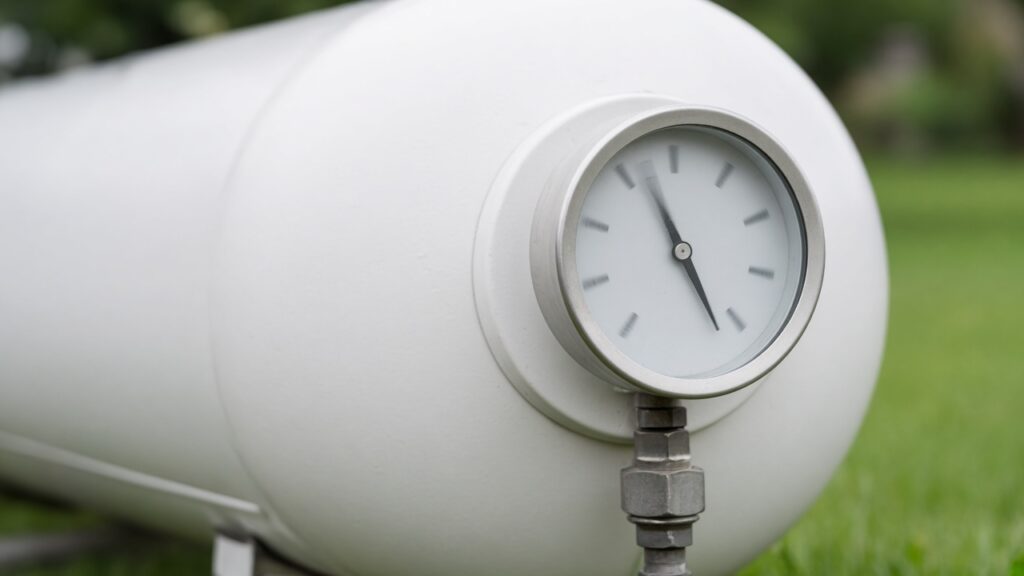
A home propane gauge shows the percent of the tank that still holds liquid. A reading of 40% on a 500-gallon tank means about 200 gallons are still in the tank. After a delivery the needle usually sits near 80%, not 100%.
The short version
Read the dial as a percent of the tank’s water capacity. Multiply that percent by the tank size to get gallons. Order a delivery while the needle is still near 30% in winter. A grill cylinder often has no useful dial. Weigh it, or read the small gauge as a rough hint only. The photo shows where the dial sits. The tick marks on it are not a reading. Use the numbers printed on your own gauge.
What the needle is counting
The round dial on a home tank is a float gauge. A float inside the tank rides on the liquid and turns the needle. The number is the percent of the tank’s water capacity that still contains liquid propane.
It is not a percent of the last delivery, and it is not a percent of the 80% fill. A needle at 30% on a 500-gallon tank means 30% of 500, which is about 150 gallons. It does not mean 30% of the 400 gallons the driver put in when the tank was filled.
| Gauge | 120-gal tank | 250-gal tank | 500-gal tank | 1,000-gal tank |
|---|---|---|---|---|
| 80% | 96 gal | 200 gal | 400 gal | 800 gal |
| 50% | 60 gal | 125 gal | 250 gal | 500 gal |
| 30% | 36 gal | 75 gal | 150 gal | 300 gal |
| 10% | 12 gal | 25 gal | 50 gal | 100 gal |
If you do not know the tank size, the gallons in that table are a guess. The size is on the data plate, or on the account at the company that fills it. The tank size chart explains why the nameplate gallons and the gallons you can burn are different.
Why a full tank reads about 80 percent
The driver stops the fill near 80% so the liquid has room to expand on a hot day. When the truck leaves, a working gauge should be near 80%. A reading of 100% is not the goal. A tank filled that high has no room left for expansion.
Write down the reading the day of the delivery. If it is already near 50% an hour after the truck leaves, the dial may be stuck, or the tank on the account may not be the tank in the yard.
The other gauge is for the driver
Home tanks have a second, smaller fitting called a fixed liquid-level gauge, or spit valve. The driver opens it while filling. Liquid comes out when the tank reaches the 80% level, and that is the signal to stop.
That fitting is not a weekly level check. Opening it releases propane. Leave it closed, and leave it to the driver.
Grill cylinders are a different dial
A 20 lb cylinder often has no float gauge at all. Some have a small screw-on gauge. Treat that as a rough hint. The accurate check is a scale.
- Find the tare weight stamped TW on the collar. That is the empty cylinder, in pounds.
- Weigh the cylinder.
- Propane left = scale weight minus TW.
- A full cylinder is about TW plus 20 pounds, which is about 4.7 gallons.
If TW is hard to read, the company that fills or exchanges the cylinder can read it. Do not store the cylinder in the house so you can weigh it in the kitchen. Keep it outside. The tank exchange guide covers swapping a cylinder when you would rather not weigh one.
When the needle is lying
Float gauges stick, especially after an ice storm. Suspect the dial if:
- It has not moved in weeks while the furnace is running.
- It reads the same before and after a delivery.
- It sits on one number through a cold month and the house is still warm.
Call the supplier and ask them to confirm the level. A monitor on the tank is the other way to stop guessing. Scheduled delivery and will-call both depend on somebody knowing the level before the tank hits empty.
When to order
In winter, call while the gauge is still near 30%. A truck may not arrive the same day. Running the tank dry shuts off the furnace, and the system usually needs a leak check before it is turned back on. That visit costs more than a normal delivery and can leave the house cold overnight.
In summer, 30% is less urgent if the only load is a water heater and a range. Still do not wait until the dial is on the peg. A stuck gauge at 10% and a stuck gauge at 40% look the same until the flame goes out.
Stop and get help if something is wrong
A rotten-egg smell, a hiss at a valve, or frost right on a fitting is a reason to leave. Get away from the tank before you use a phone, a light switch, or a car starter. From a safe distance, call 911 and the propane supplier. Do not open the spit valve to “see if there is gas.” Do not check for a leak with a flame.
Questions people ask about the dial
What should the gauge read after a delivery?
About 80% on a home tank. That is where the driver stops. A grill cylinder is labeled in pounds, not in that percent.
Is 30% almost empty?
On a 500-gallon tank, 30% is still about 150 gallons. That can be a week or a month of heat, depending on the furnace. It is the point to order, because the truck takes time and you do not want the last night of fuel to arrive during a cold snap.
Can I trust a gauge on a 20 lb tank?
Only as a hint. Weigh the cylinder and subtract the TW stamped on the collar.
Need a delivery or a second opinion on the dial?
Ask a local supplier to confirm the tank size and the level, and to put you on a schedule that fills before the gauge hits empty.
About Jennifer Whitaker
Propane industry expert and content contributor for MyPropane.com.
View all posts by Jennifer Whitaker →Related Articles

Your Essential Guide to Home Propane Safety
Nov 3, 2025 • 6 min read
This guide details crucial safety measures for handling and storing propane tanks at home to ensure your family's well-being.

Five Common Propane Tank Maintenance Mistakes to Avoid
Nov 21, 2025 • 7 min read
This article details five frequent errors in propane tank care and provides simple steps to prevent them.