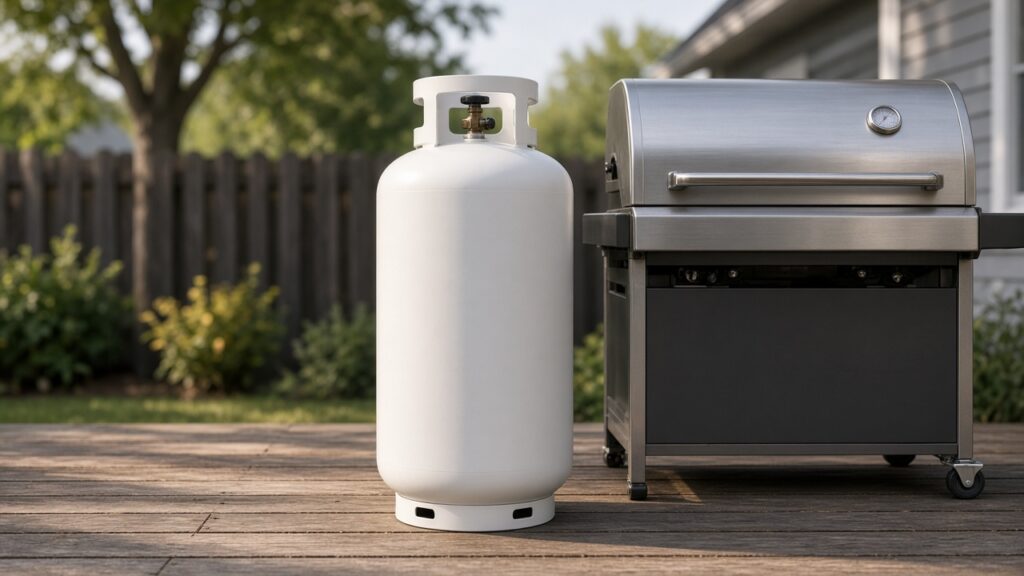
A full 20 lb propane cylinder holds about 4.7 gallons, about 430,000 BTU. Divide 430,000 by the appliance’s BTU-per-hour rating to get hours of continuous burn. A burner rated 40,000 BTU per hour, running the whole time, uses the cylinder in about 11 hours. Most grills do not run that hard, so a normal cookout uses a small slice of the tank.
The short version
Hours left ≈ 430,000 ÷ BTU per hour, if the burner runs continuously and the cylinder is full. A 20 lb cylinder is pounds of propane, not 20 gallons. Weigh it if you need to know what is left. The photo shows a grill cylinder next to a grill. It is not a specific brand, and the valve should be closed when the grill is off.
The number the label is hiding
One gallon of propane is about 91,500 BTU. A full 20 lb cylinder is 20 ÷ 4.24, about 4.7 gallons, because propane weighs about 4.24 pounds per gallon at 60°F. That is about 430,000 BTU in the cylinder.
Hours of continuous run ≈ 430,000 ÷ the BTU per hour printed on the appliance.
The rating is the burner on full, not the appliance sitting there. Use the input rating on the data plate, not a marketing word like “high output.”
| Burner input, running the whole time | Hours from a full 20 lb cylinder | Gallons used per hour |
|---|---|---|
| 12,000 BTU/h | about 36 hours | 0.13 gal |
| 20,000 BTU/h | about 22 hours | 0.22 gal |
| 30,000 BTU/h | about 14 hours | 0.33 gal |
| 40,000 BTU/h | about 11 hours | 0.44 gal |
| 60,000 BTU/h | about 7 hours | 0.66 gal |
Those hours assume a full cylinder and a burner that never cycles off. A real grill cycles. A heater on low uses less than its maximum rating.
A grill cook is usually a small piece of the cylinder
A typical main burner is stamped around 10,000 to 15,000 BTU per hour. Two burners at 12,000 each, on for an hour and a half, use 24,000 × 1.5 = 36,000 BTU. That is about 0.4 gallons, under a tenth of a full cylinder.
All burners on high is a different day. Four burners at 12,000 each are 48,000 BTU per hour, about 9 hours of continuous high fire from a full cylinder. People rarely cook that way for 9 hours. They do run a patio heater that way.
A patio heater rated 40,000 BTU per hour, left on high, uses the cylinder in about 11 hours. A three-hour evening is roughly a quarter of the tank. Check the plate on the heater. Some are hotter than 40,000.
The grill safety guide covers the leak check and shutting the valve off when you are done. The size chart puts the 20 lb cylinder next to 30 lb, 40 lb, and 100 lb tanks if the grill is not the only load.
A generator label beats a guess
Portable generators list propane use in gallons per hour or pounds per hour at a stated load. Divide 4.7 gallons by the gallons per hour, or divide 20 pounds by the pounds per hour.
Example: a generator that lists 0.4 gallons per hour on propane runs about 4.7 ÷ 0.4, about 12 hours, on a full cylinder at that load. Half load usually burns less. The portable vs. standby generator guide is the place to start if the generator is supposed to run the house, because a 20 lb cylinder is the wrong tank for that job.
How to see what is left
Many 20 lb cylinders have no trustworthy gauge. Weigh the cylinder and subtract the tare weight stamped TW on the collar.
- Propane left, in pounds = scale weight minus TW.
- A full cylinder reads about TW plus 20.
- Gallons left ≈ pounds left ÷ 4.24.
If the collar is rusty and you cannot read TW, a refill station can. A screw-on gauge is a hint, not a measurement. The home-tank gauge guide explains why those dials are a percent, which a grill cylinder is not.
When a 20 lb cylinder is the wrong tank
House heat, a tank water heater, and a standby generator belong on a delivery tank. At about 4.7 gallons, one grill cylinder is a short evening of a patio heater and a day or less of a furnace. Hauling steel every other day is the expensive way to buy those gallons. Exchange or refill is the right plan for a grill. The exchange guide covers the cage. A delivery account covers the house.
If you smell propane, stop using the cylinder
Shut the valve if you can do it without leaning into the smell. Move the cylinder outside if it is not already outside. Get away before you use a phone. A rotten-egg smell, a hiss, or frost on the valve is a leak, not a “low tank” symptom. Do not look for the leak with a flame.
Questions people ask about runtime
How many gallons are in a 20 lb tank?
About 4.7. The 20 is pounds of propane.
How many times can I grill on one cylinder?
An ordinary hour-and-a-half cook on two burners uses well under half a gallon. Many households get through a season of weekend cooks on one or two cylinders. A heater left on high all evening will not.
Does cold weather make the cylinder run out faster?
The pounds of propane do not change. In deep cold the cylinder can struggle to vaporize fast enough for a high-BTU heater, so the flame gets weak while fuel is still inside. That is a vaporization limit, not an empty tank. A delivery tank handles house loads. A grill cylinder does not.
Need a refill, or a tank that is bigger than a cylinder?
A grill can live on exchange. A furnace needs a supplier who delivers to the house.
About Jennifer Whitaker
Propane industry expert and content contributor for MyPropane.com.
View all posts by Jennifer Whitaker →Related Articles

Best Propane Tanks for Home Use: Complete Buyer's Guide
Sep 17, 2025 • 6 min read
Find the perfect propane tank for your home. Compare residential propane tanks by size, type, and features. Learn about installation,…
Propane Outdoor Kitchens and Living Spaces: Complete Guide
Sep 17, 2025 • 8 min read
Transform your outdoor space with propane-powered kitchens, grills, fire pits, and heaters. Learn about gas cooking advantages, safety features, and…